What to know before renting a tempo traveller in India boils down to understanding interstate tourist permits, state border passenger entry taxes, minimum daily mileage thresholds (250 km/day), driver duty regulations, and commercial transport licensing. Navigating India's diverse geography—from four-lane national expressways to high-altitude Himalayan hairpin bends—demands an experienced travel operator, a mechanically sound vehicle, and total clarity on all-inclusive versus per-kilometer billing. Here is the definitive operational manual based on over three decades of commercial fleet management.
How Do Interstate Permits and Border Entry Taxes Function in India?
Renting a commercial tempo traveller to cross state borders requires comprehensive understanding of Indian interstate transport regulations. When traveling from Punjab or Chandigarh into Himachal Pradesh, Jammu & Kashmir, Uttarakhand, Rajasthan, or Uttar Pradesh, your vehicle crosses multiple state transport check-posts.
Historically, commercial vehicles paid manual passenger tax at each state barrier. Under the MoRTH All India Tourist Permit (AITP) portal, authorized commercial fleet operators pay national composite fees digitally. However, states like Himachal Pradesh and Uttarakhand enforce specific local entry cess or green tax fees (such as the Green Tax barrier at Shimla and Manali). Failing to pay these valid permits can lead to severe delays, roadside impoundment, or steep spot penalties of up to ₹10,000.
At Bharat Travels, all outstation packages for tempo traveller hire in Chandigarh clearly stipulate whether interstate passenger taxes are prepaid or payable by the customer at physical toll barriers. Check our guide on 10 things to check before booking a tempo traveller to verify legitimate commercial vehicle permits.
What Are the Standard Minimum Daily Kilometer Rules in India?
Many first-time travelers renting a tempo traveller are surprised by the 250 km/day rule. Transport operators implement this baseline to cover capital depreciation, professional driver wages, and vehicle availability costs. In mountainous sectors where vehicles navigate narrow hairpin bends and steep inclines at 25 to 35 km/h, covering 150 km takes 6 to 7 hours of demanding driving.
For example, on a 5-day mountain journey to Dharamshala or Dalhousie, total vehicle billing will be calculated based on 1,250 kilometers (5 days × 250 km). If your total journey measures 1,120 km at trip completion, the billing remains 1,250 km. Conversely, if total distance reaches 1,380 km, extra distance is billed at the agreed per-kilometer rate.
Explore our transparent fleet options including the 12 seater tempo traveller and 17 seater tempo traveller to calculate precise daily route distances.
How Does Mountain and Hill Driving Differ From Plain Highway Travel?
Driving an extended wheelbase passenger van across the Rohtang Pass, Jalori Pass, or Mohan Chatti demands vastly different skills than cruising along the Delhi-Amritsar National Highway. Hill routes feature tight hairpin turns, blind curves, falling stones during monsoon showers, and steep drops that leave zero margin for driver error.
Commercial transport regulations in hill states restrict night driving on specific treacherous ghat stretches between 10:00 PM and 5:00 AM for passenger safety. Furthermore, standard plain-highway drivers often struggle with engine overheating or ride clutch plates on sustained 12% mountain gradients.
Always demand a driver with at least 7 to 10 years of proven Himalayan driving credentials. Check our regional route guides for Chandigarh to Manali tempo traveller service and Chandigarh to Shimla tempo traveller rental for seasonal hill driving protocols.
What Are the Air Conditioning (AC) Regulations in Hill Stations?
A common misunderstanding among tourists traveling to hill stations is expecting vehicle air conditioning to blast on steep alpine climbs. Operating an engine-driven AC compressor draws 15% to 20% of engine power, creating excessive thermal load when ascending steep 3,000-meter passes in second gear.
Reputable travel operators communicate this upfront during booking. In higher mountain altitudes, ambient outdoor temperatures typically range from 10°C to 20°C, rendering natural mountain air through side hopper vents far more refreshing than refrigerated air conditioning. However, on valley floor connections like Chandigarh to Pinjore or Mandi to Pandoh, vehicle AC remains operational.
Read our in-depth companion article on tempo traveller booking tips for a safe and comfortable journey to align onboard comfort expectations.
What Is the Difference Between Yellow Plate Commercial and White Plate Vehicles?
Unregulated online aggregators and roadside private operators sometimes quote deceptively low rates by dispatching white-plate private vehicles. Renting a private white-plate vehicle for a paid tour creates catastrophic legal and financial risks:
- Insurance Nullification: In the tragic event of an accident, private motor insurance policies strictly deny claims if the vehicle was engaged in commercial passenger transport for hire or reward.
- Border Seizure: State transport inspectors regularly seize white-plate tourist vehicles at border entry tolls, leaving passenger groups stranded on highways.
- Driver Inexperience: White-plate drivers often lack commercial transport heavy vehicle licenses and mandatory police background verification.
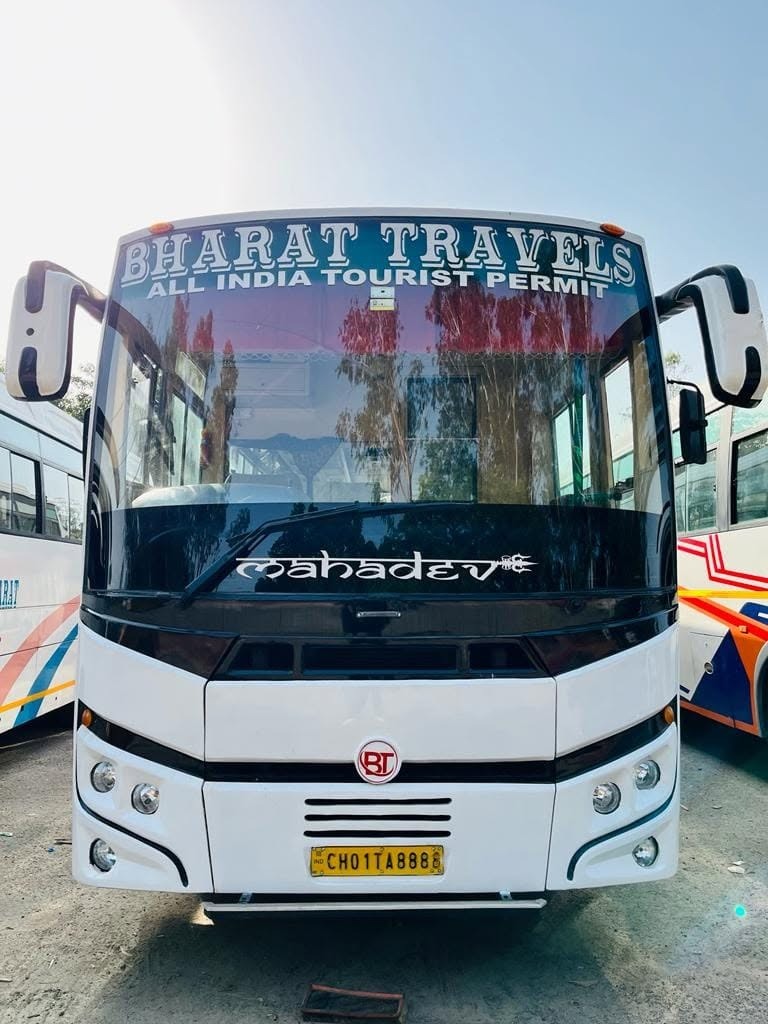
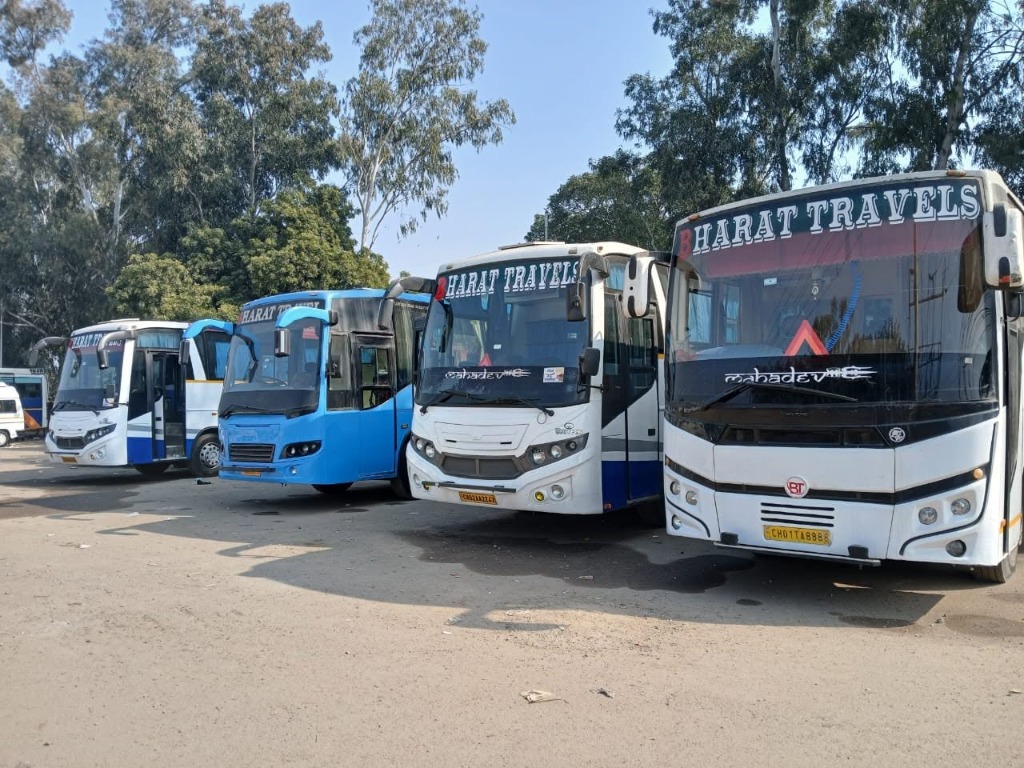
Every vehicle in the Bharat Travels fleet operates with pristine yellow commercial registration, valid commercial permits, and comprehensive passenger transit insurance coverage.
What Luggage Space Reality Should You Expect in India?
Luggage capacity is one of the most frequently underestimated factors when renting group transport in India. A standard 12-seater or 17-seater chassis operating with a passenger in every seat leaves limited space in the rear interior boot for oversized hard trolley bags.
To ensure passenger legroom remains spacious and aisles stay completely unobstructed, experienced travel agencies recommend either reserving a vehicle with 2 to 3 extra seats (such as hiring a 16-seater for a group of 12) or utilizing the secure rooftop luggage carrier. Waterproof canvas covers and heavy-duty nylon tie-down straps protect luggage from rain, highway dust, and mountain road vibration.
If your group prefers full interior luggage storage without rooftop carriers, explore the new Force Urbania luxury van featuring dedicated extra-deep rear cargo bays.
How Are Driver Allowances and Night Halts Structured?
In Indian commercial tourist travel, professional drivers spend days or weeks away from home. The driver allowance is a standard statutory contribution toward their daily food and rest. Unless you choose an all-inclusive holiday package where driver DA is already factored into the final contract price, driver allowance is billed separately per calendar day.
Travelers are not required to arrange the driver hotel room; drivers typically sleep in dedicated driver dormitories provided at Indian tourist hotels or inside the vehicle reclining cabin. However, ensuring your driver receives adequate rest, meals, and reasonable driving hours directly correlates with passenger safety.
Review our comprehensive guide on tempo traveller rental guide on price, seating, and facilities for transparent cost breakdowns.
What Regulatory Safety Equipment Must Be Inspected on Board?
Before boarding your rented vehicle, always conduct a rapid 3-minute physical inspection of vital safety hardware. Commercial vehicles without calibrated speed governors or operational GPS tracking violate Ministry of Road Transport directives.
Check tire tread depth, ensure the spare stepney wheel is fully inflated, verify the hydraulic jack and wheel wrench are onboard, and test the front and rear dual-circuit disc brakes. Taking these simple precautions guarantees absolute peace of mind during remote transit across high-altitude mountain passes.
Consult our companion checklist on important things to check before paying for a tempo traveller booking.
Comparison Table: Key Parameters & Options
| Rental Feature | Bharat Travels Verified Fleet | Unregulated Private Operators |
|---|---|---|
| Registration Category | Yellow Board Commercial Tourist Vehicle | White Board Private Vehicle (Illegal for Hire) |
| Passenger Insurance | Comprehensive Commercial Passenger Cover | Null & Void During Paid Transit |
| Permit Documentation | AITP National Tourist Permit & State Taxes Paid | No Commercial Permit; Risk of Heavy Fines |
| Speed Governor | Calibrated Speed Limiter Capped at 80 km/h | Often Removed or Tampered With |
| Driver Credentials | Commercial Heavy License + 10+ Yr Hill Records | Casual Driver Without Commercial Endorsement |
| Fleet Replacement Guarantee | Guaranteed Backup Dispatch within 2 Hours | No Replacement Available on Highway Breakdowns |
| Billing Structure | Official Written Contract & GST Tax Invoices | Unwritten Verbal Quotes with Hidden Surcharges |
Crucial Operational Checklist Before Dispatching an Outstation Tempo Traveller
Always review this hands-on checklist before making any advance deposit or setting off on your group trip:
- Confirm commercial yellow registration plates and match RC chassis numbers with your written contract.
- Inspect physical All India Tourist Permit (AITP) and annual fitness certificate valid for your journey dates.
- Check FASTag balance to prevent delays or double cash surcharges at electronic toll plazas.
- Verify that driver possesses an active commercial driver badge and valid heavy transport vehicle license.
- Test air conditioning and heating performance across front, middle, and rear cabin vents.
- Confirm onboard emergency equipment: AIS-140 GPS panic buttons, functional fire extinguisher, and medical first-aid kit.
- Record starting odometer reading with a timestamped smartphone photograph alongside the driver.
- Ensure high-altitude diesel anti-freeze additive is provided if traveling to sub-zero Himalayan regions in winter.
"In my 35 years of booking trips across North India, the single most expensive mistake travelers make is booking a vehicle purely based on the lowest per-kilometer quotation without verifying state border taxes and permit validity. Unscrupulous brokers quote ₹22 per kilometer, then ambush families at the Himachal or Uttarakhand border with sudden ₹6,000 passenger tax demands and mandatory driver hotel allowances. At Bharat Travels, we believe in radical transparency: when you book with us, every toll, permit, parking fee, and driver expense is spelled out in plain black and white before you pay a single rupee."
Real-World Customer Scenario: Lessons from North India Roads
A family of 14 from Mumbai booked a self-drive holiday through an unverified online classified broker for a 7-day tour from Chandigarh to Shimla, Kullu, and Manali. Upon reaching the Parwanoo border check-post, transport officials discovered the vehicle carried a lapsed fitness certificate and an expired interstate tourist permit. The vehicle was impounded on the spot, leaving the family stranded on the highway in the midday heat with their luggage. They contacted Bharat Travels emergency helpline at 1:30 PM. Within 90 minutes, our Chandigarh operations team dispatched a sanitized, fully permitted 17-seater luxury tempo traveller with an experienced hill driver, saving their family vacation and completing the entire circuit safely.
Detailed Route Mileage & Travel Cost Breakdown
| Destination State | Entry / Passenger Tax Structure | Permit Verification Checkposts | Typical Processing Time |
|---|---|---|---|
| Himachal Pradesh | Green Tax + State Passenger Tax (₹450 to ₹1,500/day) | Parwanoo, Swarghat, Mehatpur, Kandwal | 10 - 20 Minutes (Online Prepaid) |
| Uttarakhand | State Passenger Entry Tax based on Seating Capacity | Kalsi, Haridwar, Roorkee Border | 15 - 25 Minutes |
| Rajasthan | Per-Day Border Commercial Vehicle Passenger Tax | Shahjahanpur, Behror, Alwar Checkposts | 15 - 30 Minutes |
| Jammu & Kashmir | Commercial Toll + Passenger Entry Clearance | Lakhanpur Border Post | 20 - 40 Minutes (Security Verification) |
| Punjab & Haryana | Covered Under National Permit / FASTag Expressways | Highway Automated FASTag Plazas | Instant Electronic Deduction |
Passenger Comfort & Etiquette Guidelines for Extended Group Road Trips
- Pack soft duffel bags rather than rigid oversized hard luggage for easier onboard stowage.
- Distribute passenger seating with senior citizens and motion-sensitive travelers placed in middle cabin rows.
- Carry motion-sickness medications and dry snacks for winding mountain sectors.
- Plan regular 20-minute comfort breaks every 3 hours to allow passengers to stretch and prevent driver fatigue.
- Keep charging cords and power banks handy for individual seat USB ports.
- Maintain clear cabin aisles at all times without blocking emergency rear exit doors with loose backpacks.
- Respect driver daily rest periods to ensure peak alertness during demanding high-altitude driving.
Frequently Asked Questions
Direct answers in conversational spoken style to common customer queries:
Yes, heavy-duty Force Tempo Travellers effortlessly navigate Rohtang Pass, Spiti Valley, and Ladakh. However, local taxi union regulations at Manali and Leh require private tourist vehicles to hold valid permits. We handle all Rohtang Pass green permits and Leh paperwork in advance.
On multi-lane plain expressways, a tempo traveller comfortably covers 450 to 550 kilometers in 8 to 10 hours. On winding Himalayan mountain roads, daily travel should be capped at 200 to 250 kilometers (6 to 8 hours) to ensure passenger comfort and driver alertness.
Yes, in all-inclusive tour packages, diesel fuel, toll charges, state entry taxes, and driver DA are bundled into one fixed price. In per-kilometer rentals, fuel is factored into the per-km rate, but tolls, parking, and state entry taxes are paid separately as actuals.
Yes, all modern luxury tempo travellers and Force Urbania vans in our fleet feature individual USB fast-charging ports or 12V auxiliary sockets beside each passenger seat row.
Bharat Travels maintains an extensive network of authorized service partners and fleet stations across Punjab, Himachal Pradesh, Haryana, and Uttarakhand. In the rare event of a mechanical failure, we arrange immediate roadside repair or dispatch a replacement vehicle within 2 hours.
In all-inclusive packages, all highway FASTag tolls and routine parking fees are covered. In per-kilometer rentals, toll plaza receipts and hotel/monument parking tickets are paid directly by the client.
Under Indian transport safety laws, commercial tempo travellers are fitted with calibrated electronic speed governors restricted to a maximum speed of 80 km/h on national expressways and 40 to 50 km/h on mountain highways.
Yes, our private rental services offer complete route flexibility. For per-km rentals, extra distance and time are simply added to your final trip odometer sheet. For all-inclusive packages, minor route detours are easily accommodated with prorated fuel adjustments.
Summary and Next Steps
Planning a group trip with a tempo traveller should be exciting, stress-free, and comfortable. By verifying commercial taxi licenses, selecting the right seating configuration, checking luggage capacity, and securing written terms for tolls and driver allowances, you set your group up for a truly memorable holiday.
At Bharat Travels Chandigarh, we have been serving family vacationers, corporate teams, and pilgrims across North India since 1989. Whether you need a 12 seater tempo traveller in Chandigarh for Shimla, a 17 seater luxury coach for Manali, or a Force Urbania for an executive tour, our team is at your service 24/7. Read through our comprehensive blog guides or contact our reservations desk for customized trip itineraries.
Call +91-9814-111-122 Chat on WhatsApp